
What Is Spaced Repetition? The Science and How to Use It
Spaced repetition is a learning method where material is reviewed at gradually increasing intervals instead of being crammed into one session.
Although it is often associated with flashcards and exam preparation, the same cognitive science can help knowledge workers keep notes in Notion and Obsidian useful over time. It can also support students, lifelong learners, and anyone who wants important ideas to remain accessible.
What is spaced repetition?
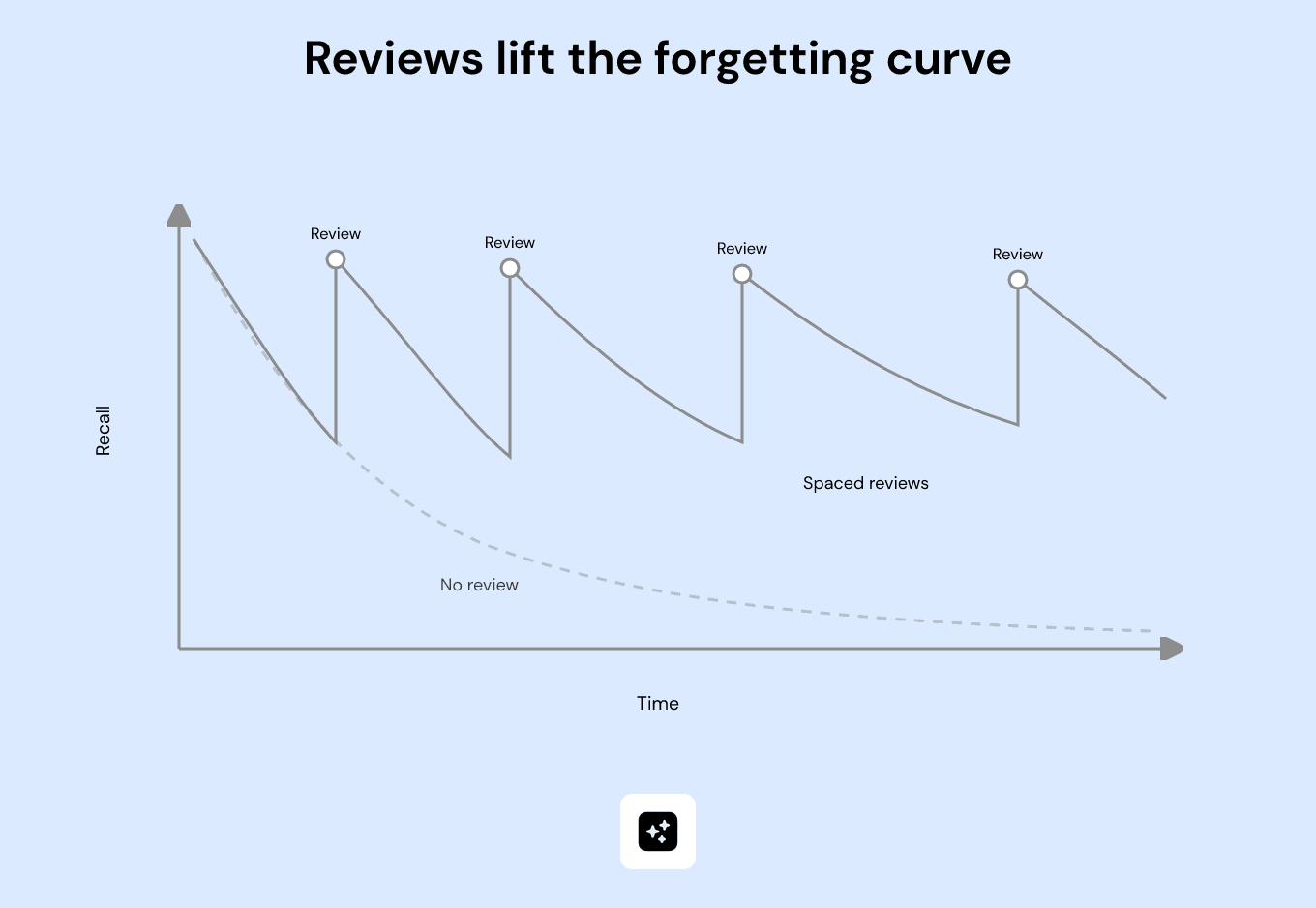
Spaced repetition is a learning technique based on repeated encounters with the same information, separated by time. The intervals expand as memory strengthens. Instead of reviewing a concept repeatedly in one sitting, a learner might revisit it after 1 day, then 3 days, 1 week, 2 weeks, and 1 month.
This approach contrasts with massed practice, commonly known as cramming, where repetitions occur close together. Cramming can create a temporary feeling of fluency, but that feeling often fails to translate into lasting recall.
An effective spaced repetition system (SRS) is not simply rereading material on a fixed timer. It combines four elements:
- Spacing: Distributing review sessions across expanding intervals of time.
- Active retrieval: Attempting to recall the concept or answer before viewing the source note or solution.
- Feedback and correction: Checking the accuracy of the response immediately to reinforce correct concepts or fix misunderstandings.
- Adaptive scheduling: Adjusting subsequent review intervals based on how easily and accurately the information was recalled.
For example, a knowledge worker might encounter an important insight in a project note today, test their recall of it in 3 days, and review it again in a week. The goal is long-term, retrievable knowledge rather than short-lived performance immediately after studying.
The forgetting curve: why memory fades by default
In 1885, German psychologist Hermann Ebbinghaus published Memory: A Contribution to Experimental Psychology (Über das Gedächtnis), documenting pioneering self-experiments with lists of nonsense syllables. By testing his ability to recall the syllables across varying delays, Ebbinghaus mapped the trajectory of memory decay and created what is now known as the forgetting curve.
The curve shows that memory loss is steep immediately after learning, after which the rate of forgetting gradually flattens out. Classic popular summaries often cite these retention milestones:
- Roughly 40% retained after 20 minutes
- About 25% retained after 24 hours
- Around 20% retained after 31 days
These figures are useful illustrations, not universal biological constants. Actual retention varies according to the meaningfulness of the material, the learner’s baseline knowledge, available retrieval cues, and the depth of initial encoding.
Modern studies support Ebbinghaus’s core model, including a direct replication by Murre and Dros (2015, PLOS ONE) that confirmed the negatively accelerated shape of the curve. Ebbinghaus also identified the principle of savings: even when a person cannot freely recall information, relearning it usually takes less time than learning it initially.
Forgetting, then, is not always total erasure. A partial memory trace may remain and become easier to reactivate. Each successful review can reset and flatten the curve, lengthening the interval before recall becomes difficult again. Spaced repetition deliberately schedules these reviews instead of leaving them to chance.
Why spaced repetition works
Spaced repetition draws on two central learning effects: the spacing effect and retrieval practice.
The two core engines
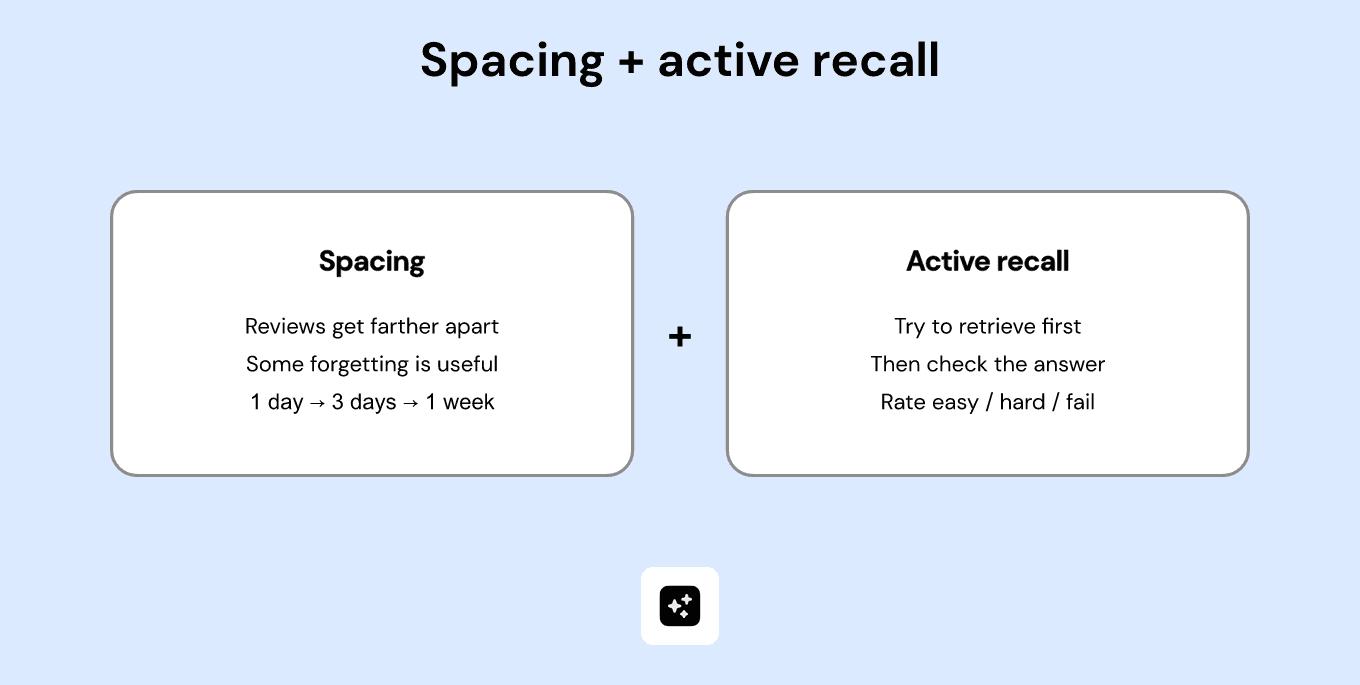
The spacing effect, also known as the distributed-practice effect, shows that spreading review sessions across time produces stronger long-term retention than massing the same repetitions together. Cramming may create immediate fluency after a study session, but spaced practice tends to perform better on delayed tests.
The second engine is retrieval practice, commonly known as the testing effect. Attempting to recall an idea before looking at the answer strengthens memory more effectively than passively rereading notes. Retrieval also exposes gaps in understanding, allowing feedback to correct them.
Complementary mechanisms
Researchers do not treat spaced repetition as the result of one definitive mechanism. Several complementary processes help explain its effectiveness:
- Desirable difficulty: A time delay allows partial forgetting, making retrieval more effortful. That productive struggle can strengthen later access to the information.
- Memory consolidation and reconsolidation: Time intervals, especially those spanning periods of sleep, allow newly formed memory traces to stabilize. Reactivating a memory during a later review triggers reconsolidation, updating and reinforcing the existing trace.
- Encoding variability: Encountering ideas across different days, mental states, and environments creates multiple retrieval routes and cues. Later recall becomes less dependent on the original study context.
The empirical evidence
Research across laboratory and classroom settings supports these principles:
- Cepeda et al. (2006) published a large-scale meta-analysis in Psychological Bulletin covering 317 experiments from 184 articles and more than 14,000 participants. The findings confirmed that distributed practice reliably beats massed study for long-term retention across verbal learning tasks.
- Cepeda et al. (2008) examined 1,354 adults in Psychological Science across 32 combinations of study gaps and retention intervals. Spaced practice produced absolute retention gains of 10–50% compared to massed practice.
- Roediger & Karpicke (2006) compared rereading with testing across different delays. After a 5-minute delay, rereading produced higher recall than testing (81% vs. 75%). Testing was superior on delayed assessments, winning 56% vs. 42% after 2 days and 61% vs. 40% after 1 week.
- Kornell (2009) illustrated a persistent metacognitive illusion: 90% of participants recalled more from spaced flashcard stacks than from massed stacks, even though they judged massed practice to be more effective while studying.
Spacing intervals and schedules that work
The right review schedule depends on the material, the desired retention horizon, and whether reviews are tracked manually or scheduled by software.
Manual schedules and rules of thumb
- The 2-3-5-7 method: This popular student rule of thumb schedules reviews on day 2, day 3, day 5, and day 7 after first learning an item, followed optionally by weekly or monthly sessions. It is easy to map onto a calendar, but it is not a published scientific algorithm and does not account for recall success or item difficulty.
- Expanding intervals: A manual progression might expand across wider horizons: 1 day → 3 days → 1 week → 2 weeks → 1 month → 3 months. Successful recall extends the next gap, while a failed item receives a shorter interval or returns for an earlier review.
- Scaling the gap to your retention horizon: A popular shorthand suggests using roughly 10–20% of the desired retention interval as the gap. However, Cepeda et al. (2008) found that optimal gaps were roughly 20–40% of the delay for a 1-week test and roughly 5–10% for a 1-year test. The ideal share shrinks as the horizon grows, so these are population-level findings rather than a plug-in formula for every learner.
- Expanding vs. equal spacing: In laboratory experiments matching total study time, expanding intervals performed roughly equally to equal spacing, such as reviewing every 3 days. Software tools still favor expanding schedules because early reviews can reduce initial failures.
Automated spacing algorithms
Modern systems reduce manual tracking by calculating intervals based on how easily each item is recalled:
- Leitner system (1970s): Devised by Sebastian Leitner, this physical card-box method promotes a card to a longer-interval box after a correct answer. An incorrect answer sends the card back to Box 1 for daily review.
- SM-2 (1987): Created by Piotr Woźniak for SuperMemo, SM-2 became the classic default scheduler for Anki. Learners rate recall quality from 0 to 5. Cards progress through intervals of 1 day and 6 days before later gaps are multiplied by an ease factor starting at 2.5. Failed cards reset their intervals.
- FSRS (Free Spaced Repetition Scheduler): An open-source modern algorithm integrated natively into Anki 23.10+ and platforms like RemNote. Rather than using fixed multipliers, FSRS models memory stability, difficulty, and retrievability to schedule reviews as predicted recall probability approaches a learner’s target desired retention, defaulting around 90%.
How to practice spaced repetition: a step-by-step guide
Spaced repetition follows a repeatable feedback loop. Whether the material lives in flashcards or personal notes, the workflow usually includes five steps:
- Learn something new: Encode the concept, fact, or note clearly during the initial study or capture session.
- Schedule the initial review: Set the first follow-up review for a short time after the initial learning session.
- Review via active recall: Attempt to retrieve the concept before checking the answer or source note.
- Rate recall honestly: Decide whether the answer came back easily, required effort, or was completely forgotten.
- Adjust the schedule: Successful recall lengthens the next interval, while a failed recall shortens or resets it.
For example, a learner studies a new concept on Monday. The system schedules the first self-test for Wednesday. After successful retrieval on Wednesday, it expands the interval and schedules the next review for the following Monday, gradually pushing future reviews weeks or months apart.
Practical setup advice
A sustainable routine keeps friction low and review volume manageable.
- Pick one job first: Start with a single use case, such as memorizing exam facts, retaining reading highlights, or resurfacing personal notes.
- Start with 10–30 items: Avoid importing an entire archive or textbook immediately. A small seed list reduces the risk of a review backlog.
- Match the retrieval format to the content: Use direct active recall questions for atomic facts and vocabulary. For complex personal notes, pair resurfacing with an open-ended question.
- Grade failures honestly: Resist the urge to glance at an answer and mark it correct. Accurate grading brings difficult items back soon enough to rebuild recall.
- Avoid day-one binging: Adding hundreds of new items in one afternoon can create a review spike a few days later. Add material in small, consistent daily batches.
- Prune your collection after a week: After seven days of reviews, evaluate the initial set. Keep high-value items, rewrite confusing prompts, and remove irrelevant or low-priority material.
Beyond flashcards: spaced repetition for personal knowledge
The Knowledge Worker’s Paradox describes a common problem in modern note-taking: as the number of notes grows, each individual note becomes less likely to be seen again. Notion and Obsidian are useful for capturing and organizing information, but they do not automatically schedule meaningful re-encounters. Over time, forgotten insights can become an inactive archive of disconnected ideas.
Personal notes also differ from exam facts. The goal is not always to memorize a fixed definition, but to keep useful thoughts accessible as projects, questions, and priorities change.
Personal Knowledge Reinforcement (PKR) applies spaced, recurring resurfacing to a person’s own notes rather than to exam flashcards or clipped external articles. It turns review into an opportunity to reconnect old thinking with current work through four activities:
- Resurface: Old notes re-enter working memory on a scheduled rhythm.
- Reconnect: A previous note appears alongside current projects and may prompt a new association.
- Refresh: Outdated thinking gets edited and refined.
- Remix: Old fragments combine into new insights, writing, and decisions.
Different tools suit different types of material:
| Job | Typical tools | What gets scheduled | Recall style |
|---|---|---|---|
| Your facts, language, exams | Anki, SuperMemo, RemNote | User-authored cards | Active grading (Again/Hard/Good/Easy) |
| What you read (books, articles, newsletters) | Readwise, Matter, Kindle exports | Highlights/quotes | Often passive rereading plus optional prompts |
| Notes you already wrote (Notion, Obsidian) | Daily Brain Bits | Existing pages/notes | Email resurfacing plus optional LLM multiple-choice quiz that hides dates, names, and key concepts |
These tools are complementary rather than interchangeable. Anki remains suited to medical school decks and language learning, while Readwise focuses on surfacing highlights from books and articles. Daily Brain Bits focuses on resurfacing existing notes and does not replace either tool.
Looking for different ways to review your reading material and highlights? Check out our guide to the top alternatives to Readwise to find the best fit for your workflow.
What this looks like in practice
Daily Brain Bits connects to Notion and Obsidian, then lets you customize the email schedule and the number of notes in each batch.
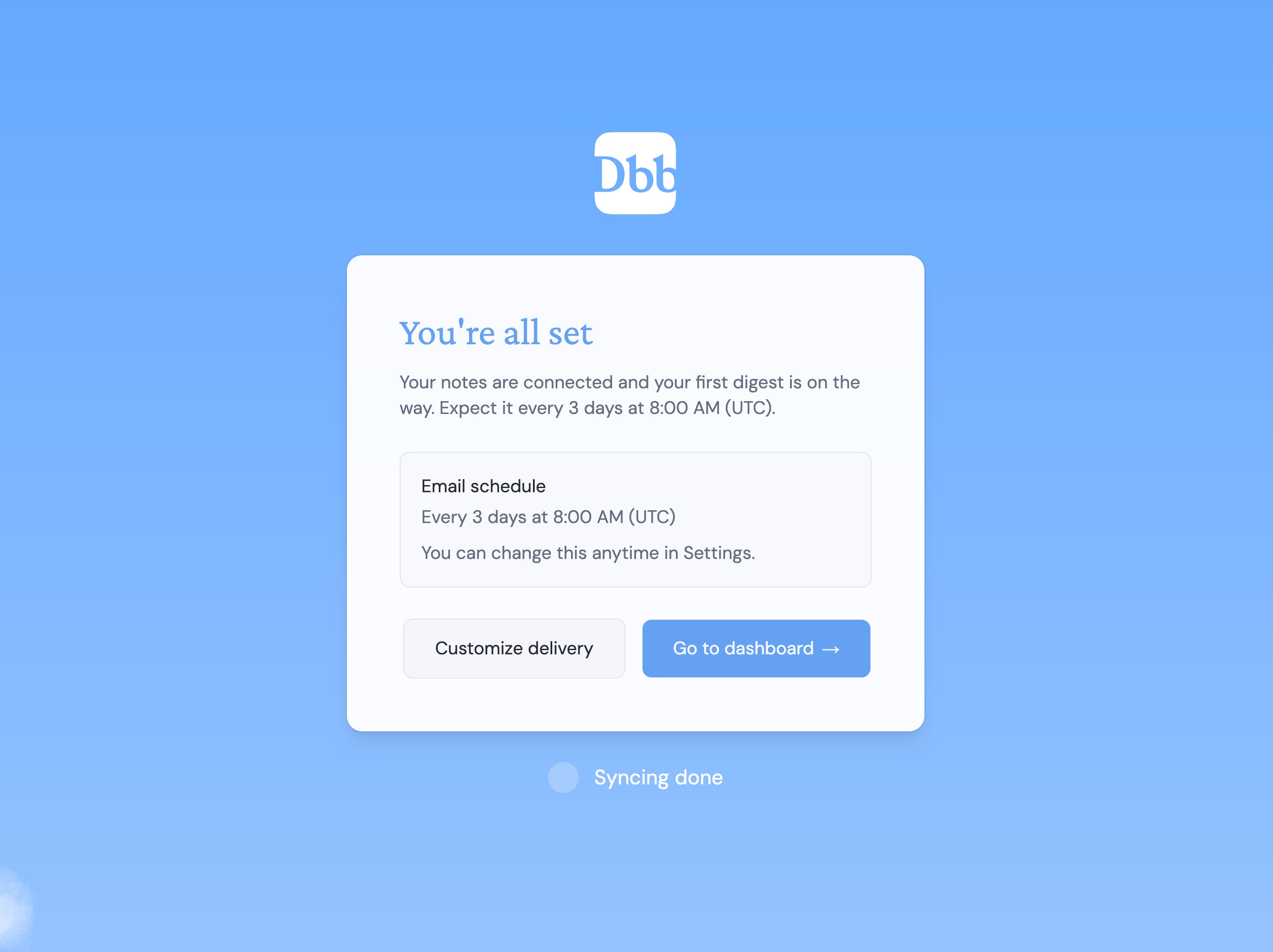
The dashboard shows the day’s selection of random notes from connected databases.
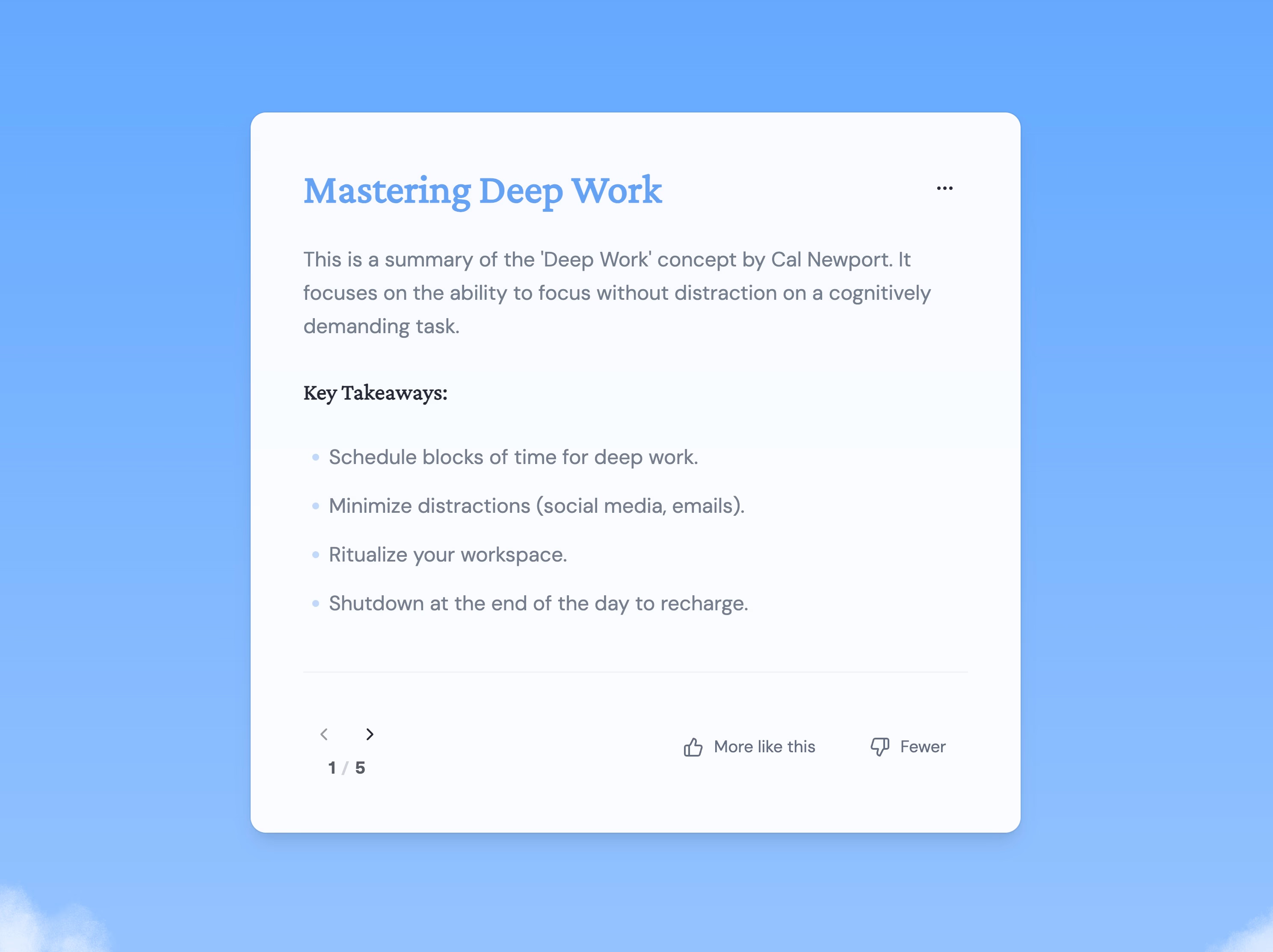
To encourage active retrieval, an LLM generates multiple-choice quizzes from the day’s notes, hiding 1–3 key concepts such as dates or names. You can prioritize or deprioritize notes to adjust their importance, and the system suggests new links between related entries. A Pro plan of around $10 is intended to include AI features and additional customization options.
Common spaced repetition mistakes and how to avoid them
Even with a good scheduler, certain habits can lead to weak learning or review fatigue.
1. Rereading instead of recalling
Passive review creates a false sense of mastery because recognition can look like understanding. The testing effect described earlier shows why active retrieval is a stronger choice for delayed retention.
- The fix: Hide the answer before checking it. Reconstruct the concept from memory before revealing the solution.
2. Trusting the cramming illusion
Massed practice feels smooth because information remains temporarily active in short-term memory. Studies show that most people learn more from spacing while still feeling that cramming works better.
- The fix: Evaluate the system with delayed tests weeks later rather than judging it by how fluent studying feels in the moment.
3. Starting too big
Importing hundreds of notes or cards on the first day can create a crushing review backlog within a week. That sudden wall of reviews is one of the most common reasons beginners abandon spaced repetition.
- The fix: Start with 10–30 items and establish a steady daily rhythm before scaling the collection.
4. Letting an algorithm fight you
In classic SM-2 schedulers, repeatedly grading difficult cards as “Hard” can reduce their ease factor until they enter “ease hell.” The cards then appear frequently without advancing, creating a frustrating cycle of reviews.
- The fix: Grade recall honestly. Let failures reset intervals with “Again,” or use a modern scheduler such as FSRS that calibrates intervals around a desired retention target rather than a rigid ease multiplier.
5. Never pruning your collection
An expanding collection can fill the queue with trivia, duplicate concepts, and outdated ideas that consume attention.
- The fix: Treat the first week after adding an item as a trial period. Keep high-value concepts that benefit from recurring review, and delete or archive the rest.
6. Treating whole evolving notes like atomic facts
Complex thoughts from a personal knowledge base rarely fit neatly into rigid question-and-answer cards. Forcing dynamic ideas into atomic prompts can strip away important context.
- The fix: For messy personal notes and project summaries, use scheduled resurfacing paired with an open-ended reflection question instead of rote flashcard drilling.
The bottom line
Spaced repetition combines strategic intervals, active recall, feedback, and adaptive scheduling to improve long-term access to knowledge. A learner can begin with a simple 2-3-5-7-style calendar or an adaptive application, then adjust the routine as review habits develop.
For knowledge workers, applying the method to personal notes can keep a growing knowledge base connected to current thinking instead of leaving it as a static archive. Daily Brain Bits puts personal knowledge reinforcement into practice by resurfacing notes and generating review questions from Notion and Obsidian.
